Guide: How to Analyse Customer Feedback with MCP
Your company collects thousands of pieces of customer feedback every month. NPS surveys, CSAT, Reviews, Yearly surveys with Qualtrics, Medallia, SurveyMonkey, Zendesk. Reviews on Trustpilot. The data is flooding. Organisations of all sizes have become master data collectors.
And, while CX KPIs travel fast within the organisation, the insights that drive quantifiable business results don't.
That's the problem MCP was built to solve.
The Feedback Paradox: More Data, Less Business Insights
Enterprise VoC programs have never been more sophisticated. Qualtrics and Medallia remain the dominant leaders in Gartner's Magic Quadrant. Organisations have invested millions in collecting customer feedback to close the "Experience Gap".
And yet, according to the Ipsos Global Voices of Experience 2026 report:
- 50% of companies say their CX KPIs don't drive actionable decisions.
- Only 13% have linked CX metrics to financial ROI.
- 20% have never even evaluated the financial impact of customer experience.
- 55% have never connected customer experience and employee experience data.
The issue isn't collection. It is its distribution.
Customer feedback lives in VoC platforms. It stays there. The product team doesn't see it. The CFO doesn't see it. The regional manager doesn't see it. The insight is trapped inside a dashboard and simplified to KPIs and basic text analysis.
This is the feedback paradox: the more data you collect, the harder it becomes to get the right insight to the right person at the right time.
Why? Customer feedback is hard data to turn into reliable intelligence:
- Customer feedback is noisy
- Customer feedback is unstructured
- Customer feedback is dynamic
- Customer feedback is raw
What is MCP, and Why Should CX Leaders Care?
The Model Context Protocol (MCP) is an open standard, originally released by Anthropic in November 2024 and now governed by the Linux Foundation's Agentic AI Foundation. Think of it as USB-C for AI: a universal connector that lets AI applications (Claude, ChatGPT, Copilot, internal agents) plug into external systems in a standardised way.
For customer feedback and customer insight analysis, this changes everything.
Instead of logging into Qualtrics to pull a report, or asking a CX analyst to extract open-text feedback, or waiting three weeks for a quarterly insight deck, anyone in the organisation can ask an AI assistant a question and get an answer grounded in real customer data.
- "What are our customers' top pain points in the <18 years segment this quarter?"
- "What's our NPS in Italy over the last 30 days?"
- "Which topics are driving negative sentiment for our onboarding flow?"
- "Generate an action plan based on detractor feedback from the last 90 days."
These aren't hypothetical prompts. They're real queries that MCP-connected Customer Intelligence solutions can answer today.
MCP without the right infrastructure is just a faster way to spread bad data. With it, you build something no enterprise has ever had: a single customer intelligence brain that every team in the organisation can query in plain language.
How MCP Changes the Way You Distribute Customer Insights
Before MCP: The N×M Integration Nightmare
Every team that wants customer insights needs a custom pipeline. Product wants data in Jira. Sales want it in Salesforce. The exec team wants it in a slide deck. The CX analyst exports CSVs, reformats them, and sends emails.
For every new data source and every new destination, you build another connector. N sources × M destinations = integration sprawl.
For the last decade, VoC platforms have produced weather reports: "it's raining complaints in EMEA", but no business transformation. Organisations check the score, nod, and move on.
After MCP: One Protocol, Every Consumer
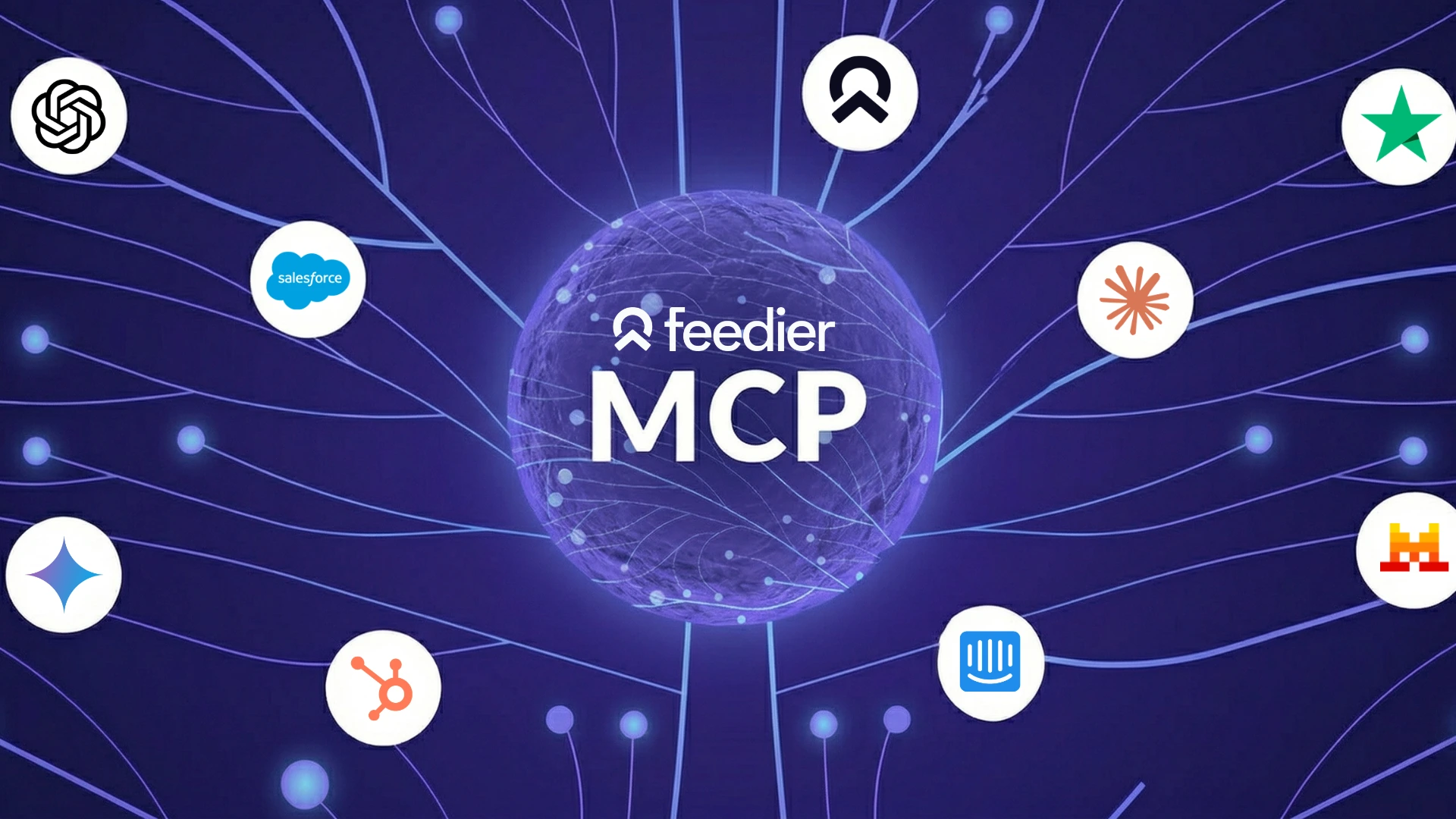
MCP flips the integration model. Instead of building custom pipelines for every team, your Customer Intelligence platform exposes a single MCP server. Any AI application that speaks MCP (Claude, ChatGPT, Copilot, a custom internal agent) can connect instantly using SSO to leverage proper data governance.
But here's what most MCP implementations get wrong in 2026: they connect the AI to a single source.
Qualtrics exposes an MCP server. Great, now your AI can query NPS data. But it can't see the support tickets in Zendesk, the churn signals in Salesforce, the complaints on Trustpilot, or the cost-to-serve data in your ERP. It's answering questions with 10% of the picture.
This is why CX teams will need an intelligence layer that sits above your VoC stack — one that ingests signals from every source (surveys, cases, social, reviews, CRM, operational data), connects the dots with AI, and exposes the Intelligence through MCP.
That changes what's possible:
- The CEO asks Claude: "What's the biggest risk to customer retention right now?" — The AI pulls from support cases, NPS trends, churn predictors, and open-text pain points, cross-referenced with revenue data, and delivers a prioritised answer with evidence.
- The product manager asks: "What are customers saying about our new checkout flow?" — The AI surfaces topic-level analysis enriched with segment data, behavioural signals, and competitive mentions.
- The regional director asks: "How does customer sentiment in Spain compare to France?" — The AI filters across every feedback channel by geography, overlays operational context, and produces a comparison no single VoC dashboard could generate.
The Compounding Effect
When customer intelligence is accessible to every role through the tools they already use, something compounds. Product teams prioritise based on evidence, not opinion. Sales teams reference real pain points in discovery calls. Executives make investment decisions backed by customer feedback and financial impact.
The organisations that Ipsos classifies as CX "Leading" (just 13% of the total) are 3× more likely to report significant financial improvement. The difference isn't that they collect more feedback. It's that intelligence reaches the people who act on it.
The Risk of Getting It Wrong
MCP is powerful. That also means it's dangerous if implemented poorly. Here are the real risks CX teams face in the next 3 years:
1. Exposing Raw Data Without Intelligence
A naive MCP implementation dumps raw survey responses into an AI's context window. The AI hallucinates patterns. It cherry-picks outlier responses. It presents anecdotes as trends.
Customer feedback is messy. Open-text responses contain sarcasm, mixed sentiment, irrelevant tangents, and cultural nuance. Without a layer of AI-powered analysis before the data reaches the MCP server, you're feeding garbage into a system that will confidently present it as insight.
The fix: Your MCP server should expose processed intelligence, not raw data.
- Topics with volume counts and sentiment scores, as well as precision scores
- Insights classified by type (pain point, competitive advantage, suggestion) as well as precision scores
- A filtering engine that can take a prompt with your operational jargon and turn it into an accurate query language
- MCP tools that generate Artifacts (reports, action plans, etc.) at the platform level, so they are consistent over time and can be trusted
2. No Governance, No Guardrails
When anyone can query customer data through an AI, you need to know who's asking what. Which teams can see which segments? Can a junior analyst access customer feedback from VIP accounts? Can a third-party contractor query your feedback corpus?
MCP supports authentication and permission scoping, but it's the responsibility of the server implementation to enforce it. Without proper role-based access and audit trails, you risk data leaks, privacy violations, and GDPR non-compliance.
The fix: Implement scoped access at the MCP server level with a centralised Customer Intelligence Platform. Use your existing data governance framework. Log every query. Treat MCP as you would any API that touches customer PII.
3. Context Collapse
Customer feedback is meaningless without context. An NPS score of 6 means something different for a luxury hotel than for a budget airline. A complaint about "slow delivery" in Germany carries a different weight than in Brazil.
If your MCP server exposes feedback without operational metadata (business unit, geography, customer segment, product line, time period) and strategic context, the AI will flatten context and produce generic answers.
The fix: Expose structured attributes alongside feedback as well as documents that give business context. Let the AI filter, segment, and compare. The richer the metadata in your MCP server, the more precise the insight.
4. The "Summary Trap"
AI is good at summarising. Too good. There's a risk that organisations start consuming customer feedback only through AI-generated summaries, losing the texture, the emotion, the exact words customers use.
The best CX leaders know that a single powerful customer comment can move a boardroom more than a hundred data points. If your MCP implementation only serves aggregated insights and never surfaces the raw voice of the customer, you've traded understanding for convenience.
The fix: Serve both. Aggregated intelligence for pattern recognition. Raw customer feedback for emotional impact and evidence. Let the consumer choose the level of depth.
What a Well-Built Customer Intelligence MCP Looks Like (Feedier's Approach)
At Feedier, we built our MCP server around a principle: the AI should distribute intelligence, not data.
Pillar 1: Break Silos Across Feedback Signals, Operations and Strategy
The existing silos we need to break are already well identified:
- Feedback signal silos: Surveys and solicited feedback (Qualtrics, Medallia, SurveyMonkey), customer support tickets (Zendesk, HubSpot, Salesforce), social networks, e-reputation (Trustpilot, Google reviews)
- Operational data silos: CRM data, product data, operational data
- Strategy data silos: Executive objectives, values and processes, internal jargon
Without these 3, it's game over before it even started.
Pillar 2: Data Governance at the Core
There are 4 technical barriers to overcome:
Must-have 1: Handle PII for compliance. Customer open-text feedback is full of personal data. Any intelligence layer sitting between your sources and MCP must detect PII automatically and anonymise it before it reaches the consumer. No anonymisation, no access.
Must-have 2: Manage roles and visibility levels. Democratising customer intelligence doesn't mean giving everyone access to all of it. The regional manager in Spain shouldn't see feedback from the UK enterprise segment. Without role-based scoping at the MCP server level, you've built an open door to data that was never meant to be open.
Must-have 3: Deploy an observation layer. Every query that hits your MCP server gets recorded. A sample of MCP responses should be automatically re-evaluated for accuracy, hallucinations, and relevance. When the MCP server fails or quality drops, someone needs to know immediately. Every response should carry a thumbs-up/thumbs-down signal.
Must-have 4: Pressure-test against five criteria. Speed, Accessibility, Context, Value per query, and Action — not just detection. Surfacing what's wrong is the straightforward part. The real gap is what happens next: triage, prioritisation, ownership, follow-through.
Pillar 3: Leverage AI Artifacts
AI artifacts are the tangible outputs an AI produces from your data — the deliverables a human can read, share, or act on.
The intelligence layer doesn't just answer questions; it produces artefacts: reports, action plans, insight briefs, and executive summaries that teams can share, assign, and track. The difference between an answer and an artifact is the difference between a conversation and a decision.
- A generated report summarising sentiment trends for Q1 across three business units
- An action plan with prioritised recommendations scoped to a specific segment
- A competitive insight brief pulling patterns from thousands of customer responses
- A board-ready summary linking customer pain points to financial impact
How to Measure Success
Lens 1: Intelligence Distribution
Before you measure financial impact, measure whether intelligence is actually reaching the organisation. Track AI credit consumption by team, and the internal score of MCP tools (volume of positive vs. negative feedback signals).
Lens 2: P&L Impact
Revenue impact. Link NPS categories directly to customer spend via your CRM. Identify the average revenue per promoter, per passive, and per detractor. The gap between the two is your net CX revenue impact — and dividing it by your NPS score gives you the financial value of a single NPS point (try the calculator).
For a large-scale operation handling 500,000 customer signals per year with an average spend of $35 per interaction, even modest assumptions (promoters spending 25% more, detractors 25% less) can produce an NPS point value of $45,000. That's the approach that gets a CFO's attention.
Operational cost impact. Every unresolved customer friction point has a processing cost (support tickets, complaints, returns, escalations). When this total exceeds the cost of resolving the root cause, you have a business case that justifies itself.
Acquisition cost impact. Promoters don't just spend more — they bring others. If your CAC is $50 and promoters refer 12,500 customers per year, that's $625,000 in acquisition spend you didn't need.
The Bottom Line

The VoC industry spent the last decade perfecting collection. The next era is about distribution.
MCP is the protocol that makes Customer Intelligence accessible to every role, in every tool, at the speed of a conversation. But the protocol alone isn't enough. Without intelligence processing, governance, and contextual depth, MCP becomes just another pipe pushing raw data into an already-overwhelmed organisation.
The companies that will win are the ones that don't just connect their feedback to AI — they connect their intelligence to AI.
That's the difference between having data and having understanding.
Feedier is an AI-powered Customer Intelligence platform that centralises VoC data from every source and exposes processed insights through MCP. Try Feedier's MCP →
Watch the Video
The Ultimate Guide to the Voice of the Customer 2025


Our articles for further exploration
A selection of resources to inform your CX decisions and share the approaches we develop with our clients.